
Nearly one in five gallons of treated drinking water in the U.S. never gets billed. That’s roughly $6.4 billion in uncaptured revenue every year, according to Bluefield Research. Most of that conversation focuses on leaks and main breaks. But there’s a quieter problem that gets far less attention: your meters are slowly, silently lying to you.
We run continuous meter health analytics across more than 3,000 meters for utilities around the country. When we look at the data by meter size, the picture gets worse where the stakes are highest:
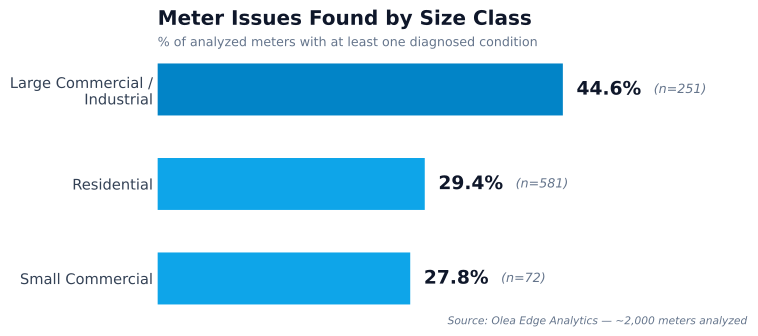
44.6% of large commercial and industrial meters have at least one diagnosed condition. These are the meters handling the most volume and generating the most revenue per account, and nearly half have something wrong. In one deployment, our analytics flagged conditions in 45% of a utility’s large commercial meters that had gone undetected through years of scheduled testing.
Why this happens
Mechanical water meters degrade. It’s physics. Moving parts wear down, sediment accumulates, and registration accuracy drifts in one direction: under-registration. Your meters aren’t randomly wrong. They’re systematically billing customers for less water than they use.
The traditional fix is age-based replacement: pull meters on a schedule, test a sample, swap the failures. But degradation isn’t strongly correlated to age. A high-consumption commercial meter might degrade faster than an older residential one seeing a fraction of the volume. Random replacement throws away good meters while leaving bad ones in the ground.
Flow testing doesn’t solve this either. A field test gives you accuracy at a few specific flow rates at a single point in time. It can’t tell you how the meter performs across the full range of flows it actually sees day to day, or how that performance is trending over weeks and months. The gap is continuous data, and most utilities don’t have it.
What’s actually going wrong
The two most common issues we find: Early crossover (113 meters), where the compound mechanism switches registers at the wrong threshold, systematically skewing the reading. Oversized meters (103 meters), meters too large for the flow they measure, spending most of their time in low-flow ranges where accuracy is worst.
These aren’t catastrophic failures. The meter still spins, the bill still goes out, and nobody notices the 3-8% that isn’t being counted. A single under-registering 4-inch commercial meter can cost tens of thousands annually.
What to do about it
Stop trusting the meter reading. AMI tells you what the meter registered, not whether the meter is registering correctly. You need diagnostics that evaluate meter health, not just meter output.
Connect pressure to revenue. Pressure instability is a leading indicator of meter issues downstream. Your PRV monitoring and meter accuracy programs shouldn’t live in silos.
Prioritize by revenue impact, not age. Target commercial and industrial meters first. That’s where small accuracy gaps translate to serious dollars.
The bottom line
Non-revenue water isn’t just a leakage problem. It’s a data problem, a pressure problem, and a revenue problem, all tangled together. The utilities that invest in continuous, connected monitoring are going to close the gap. The ones that don’t will keep losing one in five gallons.