When I walk into a mayor’s office to make the case for meter health analytics, I don’t lead with technology. I lead with a financial argument. Here’s the one we make, backed by data from real deployments.
The revenue you don’t know you’re losing
Large commercial and industrial meters are the revenue backbone of any utility. The top 1-2% of meters by size can represent 30% or more of billed revenue. When these meters under-register, the money doesn’t show up as a line item loss. It just quietly never arrives.
Bluefield Research estimates $6.4 billion in uncaptured water revenue annually across the U.S. Leaks get the headlines, but meter inaccuracy is the silent partner. A single under-registering 4-inch commercial meter can cost $20,000 to $80,000 per year in lost revenue. Unlike a main break, nobody calls to report it.
What we found across 3,000+ meters
We run continuous meter health analytics across multiple utility deployments. The condition rates vary, but the pattern is consistent: a significant share of large meters have diagnosable problems that aren’t being caught.
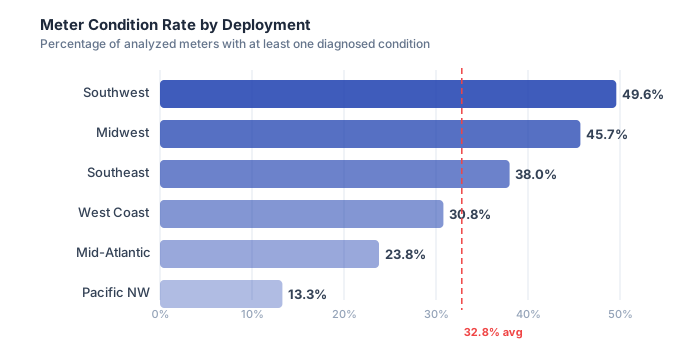
Across more than 3,000 meters, roughly a third had at least one diagnosed condition. We’ve identified over 1,200 conditions spanning 47 diagnostic categories, with error rates ranging from 13% to 50% depending on the utility and meter population.
The most common issues: Early Crossover (485 cases), where compound meters switch measuring elements at the wrong threshold, systematically under-counting. Oversized meters (358 cases), spending most of their time in low-flow ranges where accuracy is worst. Measuring Element Malfunction (82 cases), where internal components have degraded past reliability.
None of these announce themselves. The meter keeps spinning. The bill keeps going out. The gap just grows.
Why testing once isn’t enough
Here’s the number that changed how we think about this: 59 meters across our deployments initially showed no problems, then later developed diagnosable conditions.
They passed. They were clean. If we had tested them once and moved on, they would have stayed in the ground with a clean bill of health while their accuracy quietly degraded. A flow test gives you accuracy at a few specific flow rates on one day. It can’t tell you how performance is trending, whether crossover behavior is drifting, or whether a measuring element is beginning to wear.
Some of our meters have been analyzed over 30 consecutive periods. That longitudinal view catches what snapshots miss: the slow degradation curve that turns a healthy meter into a revenue leak.
Putting a number on it
A simple framework any utility director can run:
- Count your large commercial meters. These are your highest-revenue, highest-risk assets.
- Apply the error rate. Our data shows roughly 1 in 3 has a condition. 30% is a reasonable starting assumption for an aging population.
- Estimate the per-meter gap. A 4-inch meter serving a mid-size business might process $200,000-$400,000 in annual billable water. Even a conservative 5% under-registration is $10,000-$20,000 per meter, per year.
- Multiply. 100 large commercial meters, 30 with conditions, 5% under-registration: $300,000 to $600,000 in annual revenue that never hits your books.
This isn’t theoretical. In one deployment, we projected $582,000 in recoverable revenue from repairs to just nine meters. The recovery from a handful of targeted repairs paid for the entire monitoring program many times over. Across our customer base, the annual cost of continuous monitoring typically represents less than 10% of the revenue recovered per meter with a diagnosed condition.
Where this leaves utilities
Water rates are going up everywhere. Customers and regulators expect accountability for every dollar. When a utility can demonstrate it’s capturing every gallon it treats and delivers, that credibility strengthens rate cases and earns public trust.
The underlying question is simple: do you know whether your highest-revenue meters are measuring accurately right now? Not last quarter. Not at the last scheduled test. Right now.
Most utilities don’t. The data suggests roughly a third of their large meters have something worth investigating. And the 59 meters in our data that developed conditions after initially testing clean are a reminder that accuracy isn’t static. It drifts. The only way to catch it is to keep watching.